
No Special Dress Code
Except for the JSA Tour, there is no dress code for other DMZ tours. We strongly recommend wearing comfortable shoes in order to explore the Third Tunnel.

Book with confidence. Full tour price is transparently disclosed before payment.
Enjoy the unforgettable DMZ tour with transparent pricing policy.
✓
Best Available Price
✓
No Hidden Fees
✓
No Surprise Charges
✓
Clear Total Price Before Payment


We work hard to offer the same DMZ tours at lower prices than many major booking sites.

Please tell other travelers about DMZTOURS.com by sharing it in travel forums, Facebook groups, Reddit communities, or anywhere people ask for Korea travel advice.

Your recommendation helps us reach more travelers without spending money on expensive advertising, allowing us to keep our prices low.
Except for the JSA Tour, there is no dress code for other DMZ tours. We strongly recommend wearing comfortable shoes in order to explore the Third Tunnel.
The DMZ is a restricted security area, and visitor identities may be checked at military checkpoints. Every international visitor must bring the original and valid physical passport on the day of the tour.
Regular public tours to the Joint Security Area (JSA) at Panmunjom are currently unavailable following a July 2023 incident in which a U.S. soldier crossed into North Korea during a guided visit.
In 2026, DMZ tours leaving from Seoul are operating normally. The Korea Demilitarized Zone (DMZ) tour is a special experience.
It is one of the most dangerous borders in the world, but the areas where tourists can enter are strictly managed. The tour usually visits Imjingak, the Third Infiltration Tunnel, Dora Observatory, and Unification Village. Because of the integrated reservation system and the use of public data, it has become more convenient for visitors, and it is also easier to predict the number of visitors.
The Joint Security Area, or JSA, is operated separately from normal DMZ tours.
Panmunjom, also called the JSA, has been closed to normal visitors since 2023. At this time, it is still not possible to visit there through a tour. DMZ tours enter an area controlled by the military. Because of this, the tour can be stopped or canceled without notice, depending on the situation that day.
Clear pricing with no hidden fees or surprise charges
Enjoy great tours at competitive local prices
Secure booking with clear information and pricing.
The JSA is located 48km northwest of Seoul, South Korea and 10km east of Gaesong, North Korea. After concluding a Truce Agreement in 1953, it was decided to be a Joint Security Area between UN and North Korea. It is a small space where the distance between the front, rear and right and left guards is only 800 meters.
In 1950, there were only a few straw houses in the village before 25th of June. The truce talks between 1951 and 1953 were held, and it was known all over the world. The truce talks, which began with a tent for the first time, were held for a year and nine months. After the truce talks were over, a wooden building was built in the vicinity to sign the truce agreement. Then, it moved in present place. After The Truce Agreement was signed here in July 1953, it became a "Joint Security Area" between the United Nations and North Korea. From August to September of the same year, prisoners were exchanged for one month.
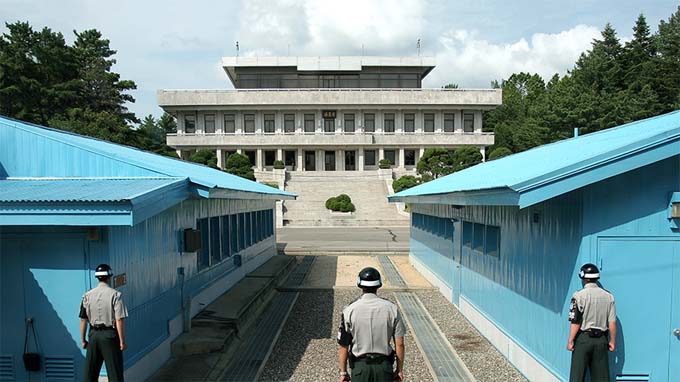
Panmunjeom was mainly used as a place to manage the truce. The North-South Red Cross Preliminary Talks, held on 20th of September,1971, has been used not only as a venue for The Military Armistice Commission, but also as a place for contact and talks between North and South Korea and as a transit point between the two Koreas. Within the Joint Security Area, there are the main conference hall of the Military Armistice Commission and the conference room of the Neutral Nations Commission of Supervision. The Military Demarcation Line indicates Mike line that is passing through the middle of a conference table set up in the conference room of The Military Armistice Commission. The U.N. and North Korean flags on the table are also symbols of Military Demarcation Line.
In addition, there is a bridge called ‘Unreturned Bridge’ that symbolizes the division of people in the west of Panmunjom. This is the name of prisoners of war exchanged through the bridge since the 1953 Truce Agreement. However, the bridge was closed due to "The Axe Murder Incident". In August 1976, two U.S. military officers were killed with axe by North Korea soldiers in the Panmunjeom Joint Security Area. In this incident, a Military Demarcation Line was set up within the JSA.
Now The Joint Security Area is safer and more peaceful than you think. Our tour guides of ‘DMZ TOURS’ will explain in easy and detailed the history and process from June 5, 1950 when the Korean War started to April 2018 when the inter-Korean summit was held.
Nature · History · Peace
The DMZ is more than a military border. It is a rare place where war scars, untouched nature, and the hope for peace all exist side by side.